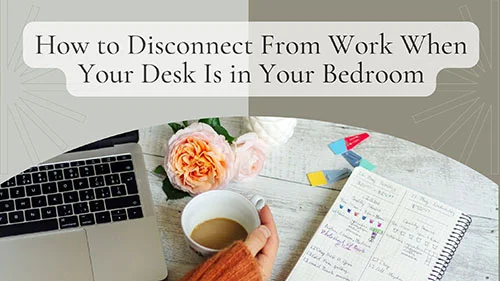
Working from home is convenient until your bedroom starts feeling like an office that never closes.
When your desk is beside your bed, finishing work does not necessarily feel like finishing work. Your laptop is still visible, unfinished tasks are still within reach, and tomorrow’s deadlines can follow you into the evening.
The solution is not always a bigger apartment or a separate home office. Sometimes, you simply need to create clearer boundaries between your work environment and your rest environment.
Here are practical ways to disconnect from work when your bedroom is also your office—even if you live in a small space.
Why It Is Hard to Stop Thinking About Work in a Bedroom Office
In a traditional workplace, leaving the building creates a natural transition between professional and personal time.
When you work from your bedroom, that transition disappears.
Your brain may continue associating the room with:
- Unfinished tasks
- Emails and notifications
- Deadlines
- Meetings
- Performance pressure
- The expectation that you should always be available
This does not mean something is wrong with you. It means your environment contains very few signals that the workday has ended.
The goal is to create those signals intentionally.
1. Create a Consistent Shutdown Routine
One of the most effective ways to end the workday is to stop ending it randomly.
Instead of closing your laptop in the middle of a task and immediately moving into your evening, create a short, repeatable shutdown routine.
A practical five-minute version could look like this:
- Review unfinished tasks.
- Write down the three most important priorities for tomorrow.
- Check whether anything genuinely requires a response today.
- Close work-related tabs and applications.
- Shut down or put away your computer.
The important part is not the exact routine. It is repeating the same sequence often enough that it becomes a recognizable ending to your workday.
A simple shutdown note
Before closing your laptop, write:
Done today:
What I completed.Still open:
What remains unfinished.First step tomorrow:
The next action I need to take.
This reduces the temptation to keep mentally reviewing unfinished work while you are trying to relax.
2. Make Your Workstation Less Visible
If your desk is directly in your line of sight from bed, it can continue to act as a visual reminder of work.
You do not necessarily need to remove the desk. You need to reduce its presence outside working hours.
Depending on your space, you could:
- Put your laptop inside a drawer or bag.
- Close your monitor or turn it away from the bed.
- Store your keyboard and mouse in a box.
- Use a folding screen or room divider.
- Cover a small workstation when it is not in use.
- Place work equipment on a shelf instead of beside your bed.
- Use a curtain or visual partition in a studio apartment.
The principle is simple:
If you cannot create physical separation, create visual separation.
Even a small change can make the room feel less like a permanent workplace.
3. Give Your Laptop a “Home” Outside Work Hours
A laptop that remains open on the bed or desk can make work feel permanently available.
Create a specific place where your work equipment goes after the workday:
- A drawer
- A backpack
- A cabinet
- A shelf
- A dedicated box
- A section of your wardrobe
This is especially useful if you work from a laptop and do not have a permanent desk.
The physical act of putting the computer away creates a clear ending that simply closing the lid may not provide.
4. Recreate a Commute—Even If It Takes Only Ten Minutes
One reason commuting can help people transition out of work is that it creates time between professional responsibilities and personal life.
You can recreate a smaller version of that transition.
After finishing work, try one of these:
- Walk around the block.
- Buy a coffee or tea nearby.
- Take a short shower.
- Change clothes.
- Stretch for ten minutes.
- Listen to a specific playlist while walking.
- Sit somewhere outside your workspace.
- Go to a nearby grocery store.
- Call a friend while taking a short walk.
The activity itself is not the main point.
The point is to create a clear sequence:
Work ends → transition activity → personal time begins.
You do not need a 45-minute commute to create that separation.
5. Change Something About the Room
Your brain responds to environmental cues.
If your bedroom looks exactly the same at 9 p.m. as it did during a stressful client meeting, the transition into rest may feel incomplete.
Try changing one or two environmental elements after work:
- Turn off bright work lighting.
- Switch to a warmer lamp.
- Open the window.
- Change the room temperature if possible.
- Put on different music.
- Move from your desk to another chair.
- Make the bed.
- Change from work clothes into comfortable clothes.
- Avoid continuing work while sitting in bed.
These actions may seem small, but they help create a different context for the evening.
6. Stop Using Your Bed as an Extension of Your Office
One of the easiest ways to make work feel endless is to move from the desk directly into bed while continuing to answer messages.
For example:
“I will just reply to one more email from bed.”
That one email can become another task, another notification, and another 40 minutes of work.
Whenever possible, create a rule:
The bed is for rest, not for finishing the workday.
If you need to do something urgent, use your desk or another designated location rather than turning your sleeping space into a second workstation.
7. Create a Clear “No More Work” Signal
A shutdown routine works better when it includes a final action that consistently signals the end of the day.
This could be:
- Turning off your desk lamp.
- Closing the door or divider.
- Putting your laptop away.
- Changing into evening clothes.
- Starting the same post-work playlist.
- Going outside for a short walk.
- Making tea.
- Reading a physical book.
- Starting a personal activity that you enjoy.
The signal should be easy to repeat.
You are not trying to force yourself to stop thinking instantly. You are building a predictable transition.
8. Use a “Parking Lot” for Unfinished Thoughts
Sometimes the problem is not the room itself. It is the feeling that you might forget something important.
If an unfinished task keeps returning to your mind, write it down.
Create a note titled:
Tomorrow — Do Not Forget
Add:
- The task
- The next action
- Any relevant deadline
- Anything you need to remember
For example:
Follow up with the client about the revised proposal.
Next action: Send the updated version by 10:00 tomorrow.
This gives your brain a place to store the thought instead of repeatedly rehearsing it.
Writing down unfinished tasks can help reduce the feeling that you must keep thinking about them to avoid forgetting them.
9. Set a Realistic End-of-Day Boundary
A boundary is difficult to maintain if it is vague.
Instead of saying:
“I should stop working earlier.”
Try:
“I finish client work at 6:30 p.m. unless there is a genuinely urgent issue.”
Or:
“After 7 p.m., I only respond to emergencies.”
The exact time will depend on your schedule, clients, country, and time zones.
For international freelancers, a strict boundary may need to be more flexible. However, flexibility does not mean permanent availability.
You can create different rules for different days:
- Client meeting days
- Deep work days
- Deadline days
- Friday shutdown
- Weekend availability
The goal is to make your availability intentional rather than automatic.
10. If You Live in a Small Space, Create Zones Instead of Rooms
Not everyone has the luxury of a separate office.
If your desk must remain in your bedroom, divide the room into functional zones.
For example:
Work zone
- Desk
- Monitor
- Laptop
- Work chair
- Office lighting
Rest zone
- Bed
- Reading light
- Personal items
- Relaxation activities
Transition zone
- Clothes
- Walking shoes
- Tea or coffee
- Journal
- Book
- Small storage area
Even when the room is physically small, assigning different purposes to different areas can make the space feel less psychologically mixed.
You are creating boundaries through function rather than architecture.
A Simple 10-Minute Shutdown Routine
If you want a practical routine to test this week, try the following:
Minute 1–2: Review
Check what you completed and what remains open.
Minute 3–4: Plan
Write tomorrow’s first task and any important deadlines.
Minute 5: Clear
Close work tabs and organize your desk.
Minute 6: Store
Put away your laptop or work equipment.
Minute 7: Change
Change clothes or switch off your work lighting.
Minute 8–10: Transition
Walk outside, stretch, make tea, or move to another part of your home.
The routine does not need to be perfect. It needs to be consistent enough to become familiar.
What If You Still Need to Work Late?
Remote work does not always fit neatly into a traditional 9-to-5 schedule.
You may work with clients in different time zones, handle urgent requests, or have periods of intense deadlines.
The goal is not to pretend that work never happens at night.
Instead, distinguish between:
Planned flexibility
You intentionally choose to work later because it fits your schedule.
Accidental overwork
You keep working because the laptop is visible, notifications continue, and there is no clear stopping point.
The first can be part of a healthy flexible schedule.
The second is often what creates exhaustion.
Common Mistakes to Avoid
Leaving work applications open all evening
Visible notifications can keep your attention attached to work.
Working from bed regularly
This can make it harder to associate the bed with rest.
Using your phone as a second office
Moving from laptop email to phone email is not a real shutdown.
Creating an unrealistic routine
A 12-step evening ritual is unlikely to survive a busy week.
Treating every message as urgent
Not every notification requires an immediate response.
Changing your schedule every day
A consistent baseline is easier to maintain than constantly reinventing your boundaries.
Final Takeaway
You do not need a separate office to create a meaningful boundary between work and personal life.
When your desk is in your bedroom, the most useful strategy is to create deliberate signals that work has ended:
- Finish with a shutdown routine.
- Put away or hide your equipment.
- Change your environment.
- Create a short transition activity.
- Write down unfinished tasks.
- Keep your bed associated with rest.
- Set realistic availability boundaries.
Your bedroom may still contain your desk.
But it does not have to remain your workplace all night.
Frequently Asked Questions
How can I stop thinking about work after working from my bedroom?
Create a consistent shutdown routine, write down unfinished tasks, and physically put away your work equipment. The goal is to give your brain a clear signal that work has been postponed until tomorrow.
Should I cover my desk after work?
If your desk is constantly visible from your bed, covering it or reducing its visual presence may help create a stronger separation between work and rest.
Is it bad to work from a bedroom?
Not necessarily. Many people have limited space. The challenge is not the bedroom itself but the lack of boundaries between work, sleep, and personal time.
How do I create work-life balance in a small apartment?
Use separate zones, store work equipment after hours, create a shutdown routine, and avoid using your bed as a regular extension of your workspace.
What should I do if I work with clients in different time zones?
Create defined availability windows and communicate them clearly to clients. Flexibility is useful, but permanent availability can make it difficult to recover after work.
How long should a shutdown routine take?
Even five to ten minutes can be useful. A short routine that you repeat consistently is usually more practical than a complicated routine that you abandon after a few days.
The Global Worker Editorial Note: This article provides general productivity and work-life organization suggestions. It is not medical or mental health advice. If persistent sleep problems, anxiety, or severe work-related distress are affecting your daily life, consider speaking with a qualified professional.
Leave a Reply